𝓔𝓿𝓸Sem is a scientific project meant to explore the “Evolving Semantics” at play in the world's languages. It brings in one place the vast knowledge acquired by generations of scholars on semantic links, for a large array of language families. Our purpose is to observe empirically the way languages have built semantic connections between concepts, through the historical evolution of their lexicons.
| 𝓔𝓿𝓸Stats |
|---|
𝓔𝓿𝓸Sem rests on a large dataset collated from a variety of sources, which consist of lexicographic data organised by etymology [see their full list on this page]. The size of our dataset evolves constantly: the 𝓔𝓿𝓸Stats table here provides the latest numbers. This makes 𝓔𝓿𝓸Sem a powerful resource for studies in semantics, whether they target synchrony (colexification) or diachrony (dialexification).
Navigating 𝓔𝓿𝓸Sem
-
𝓔𝓿𝓸Sem builds around the notions of colexification and dialexification. It combines graphs with tables, to display the relations between concepts, across the world's families.
→ Get started on 𝓔𝓿𝓸Sem. -
𝓔𝓿𝓸Sem visualises the internal semantic diversity of each cognate set in the form of “𝓔tymographs”.
→ Explore our 𝓔tymographs – and follow our online tutorial. -
𝓔𝓿𝓸Sem analyses the proximity, synchronic and diachronic, that language families establish among concepts.
→ Search 𝓔𝓿𝓸Concepts, our interactive catalogue of concepts, and filter etyma based on their dialexification patterns. -
Each of these data points can be retrieved through our search engine.
→ Use our 𝓔𝓿𝓸Search engine to filter the database by source languages, etyma, languages, words, and/or concepts. -
Thanks to the menu “𝓔𝓿𝓸Lists”, you can retrieve specific index pages for every language or source language represented on 𝓔𝓿𝓸Sem:
→ Search through the index of all languages, or the index of all source languages. -
You can download our 𝓔𝓿𝓸Sem dataset, to run your own projects based on our results
→ Visit our download area. -
𝓔𝓿𝓸Sem is being developed by a team of researchers and programmers based at CNRS—LaTTiCe (Paris)
→ Meet our team.
Getting started on 𝓔𝓿𝓸Sem
The purpose of 𝓔𝓿𝓸Sem is to observe empirically the way the world's languages have built semantic connections between concepts, through the evolution of their lexicons. Thus in many parts of the world, a word that meant ‘sky’ at some early stage, was later used to mean ‘day’. When a given language uses a single word to encode these two concepts, we speak of colexification (François 2008): e.g. Mandarin Chinese colexifies ‘sky’ & ‘day’ using the word 天 tiān. 𝓔𝓿𝓸Sem can be used as a rich source for colexification studies – a synchronic property of individual languages.
But 𝓔𝓿𝓸Sem goes beyond colexification. We observe how meanings are related not just within each language, but also from language to language, as words are inherited through history, and travel across space. 𝓔𝓿𝓸Sem builds on the new concept of dialexification – that is, the case when two meanings are attached to words that share the same etymology (François, f/c). The units of observation are not individual words, but word families, or cognate sets – that is, all the words that are descended from a single etymon.
When observing different languages, two words are cognate if they descend from the same etymon: e.g. French lire and Spanish leer ‘read’ both descend from Latin lego, through regular sound change. In fact, Latin lego ‘read’ and Ancient Greek λέγω legō ‘count, say’ are also cognate, because they both descend from the PIE etymon *legeti.
Two meanings are dialexified iff they are attached to cognate words, i.e. words that descend historically from the same etymon. In our example, the concepts count (one of the senses of Greek λέγω) and read (Latin lego and its descendants) are dialexified in the Indo-European family, because they are attached to cognate words – since both λέγω and lego reflect the same etymon *legeti. We could also say that the PIE etymon *legeti, through its descendants, dialexifies the two meanings count and read. This can be represented by a simple formula: PIE *legeti → {count : read}.
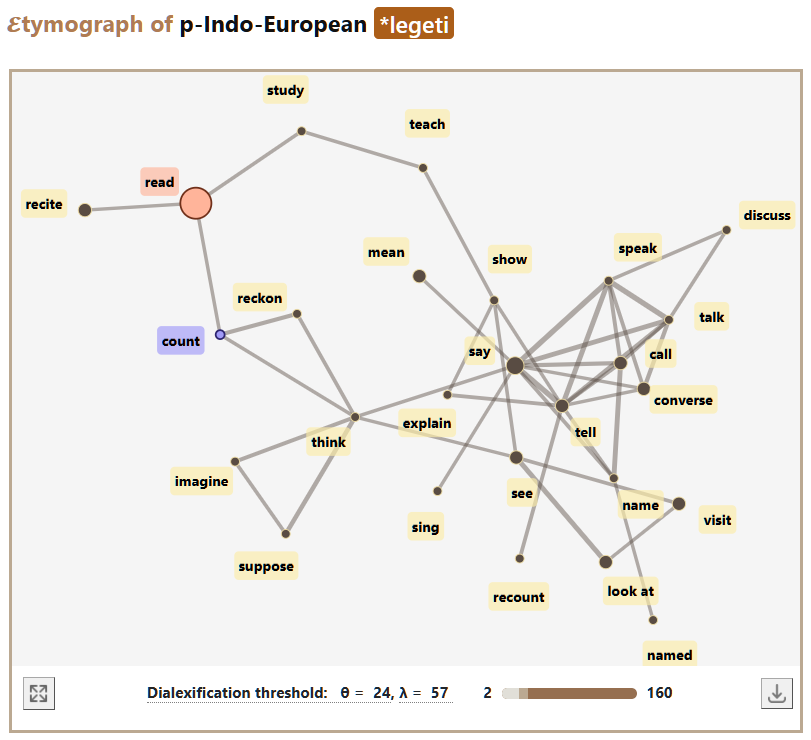
Besides the examples of Greek or French we just cited, the PIE etymon *legeti has a total of 79 descendants (or “reflexes”) in our database. If we take into account all their senses, we realise that the cognate set under *legeti includes 56 different meanings. Some of these are visible on Fig. 2 on this page:
PIE *legeti → {count : read : recite : study : teach : show : explain : tell : say : speak : think : imagine, etc.}.
We call “etymograph” the graph that brings together all the meanings associated with the descendants of a given etymon [→ Click here to view the etymograph of PIE *legeti]. Such etymographs are a great way to visualise all the meanings that are associated with (or “dialexified by”) a given cognate set.
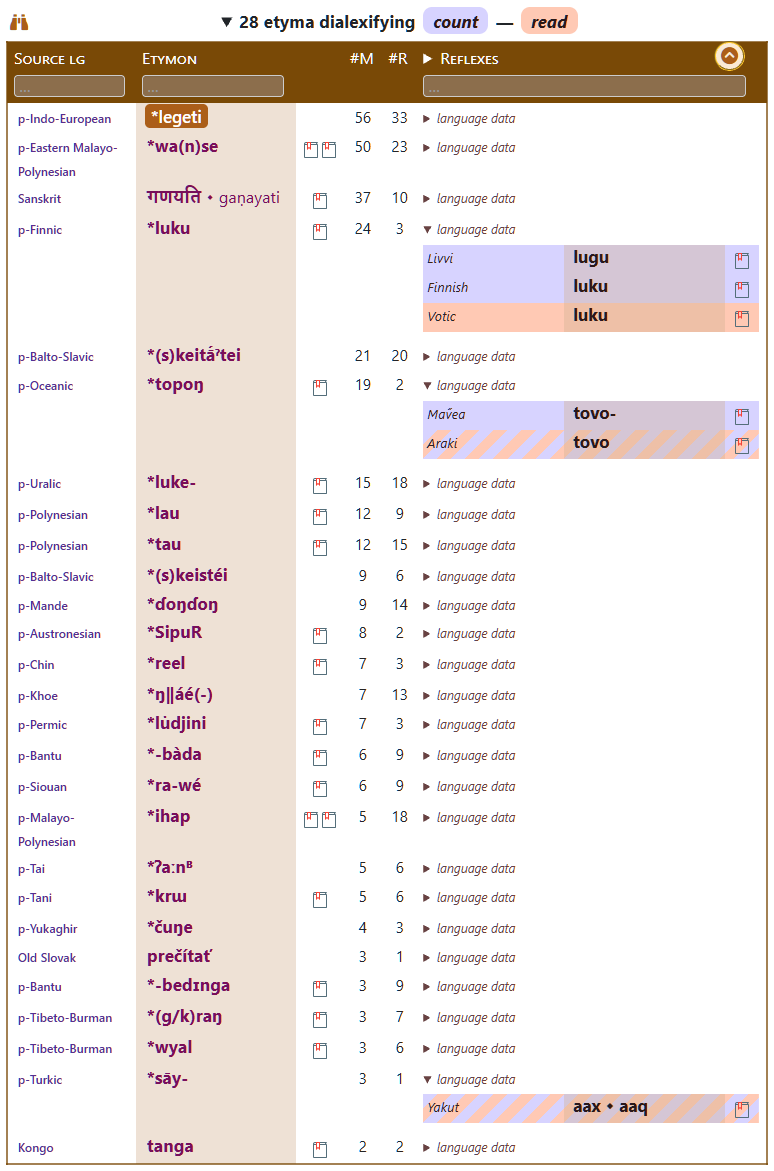
But our database can do much more than visualise a single set of etymologies: it can also compare semantic links across language families [Fig. 1] For example, the 𝓔𝓿𝓸Sem database tells us that the semantic link {count : read} is far from unique to Indo-European: the same dialexification is attested in 28 cognate sets around the world. (We say that its dialexification score delta is δ=28.) Thus, if on the etymograph of *legeti you select the two meanings count and read, this opens a table [Fig. 3]: this is the list of all 28 cognate sets that also dialexify {count : read}.
Among these results, if we take the descendants of p-Finnic *luku, we see that Finnish luku means count (and not “read”), while Votic luku means read (but not “count”). This is a case of (pure) dialexification, which locates the semantic link {count : read} at the level of the cognate set as a whole. Sometimes, the link is attested within a single language: e.g. in Araki, an Austronesian language from Vanuatu, the word tovo can mean both count = read; the same happens with the word аах in Yakut (Turkic, Siberia). Such examples of colexification are just a special case of dialexification.
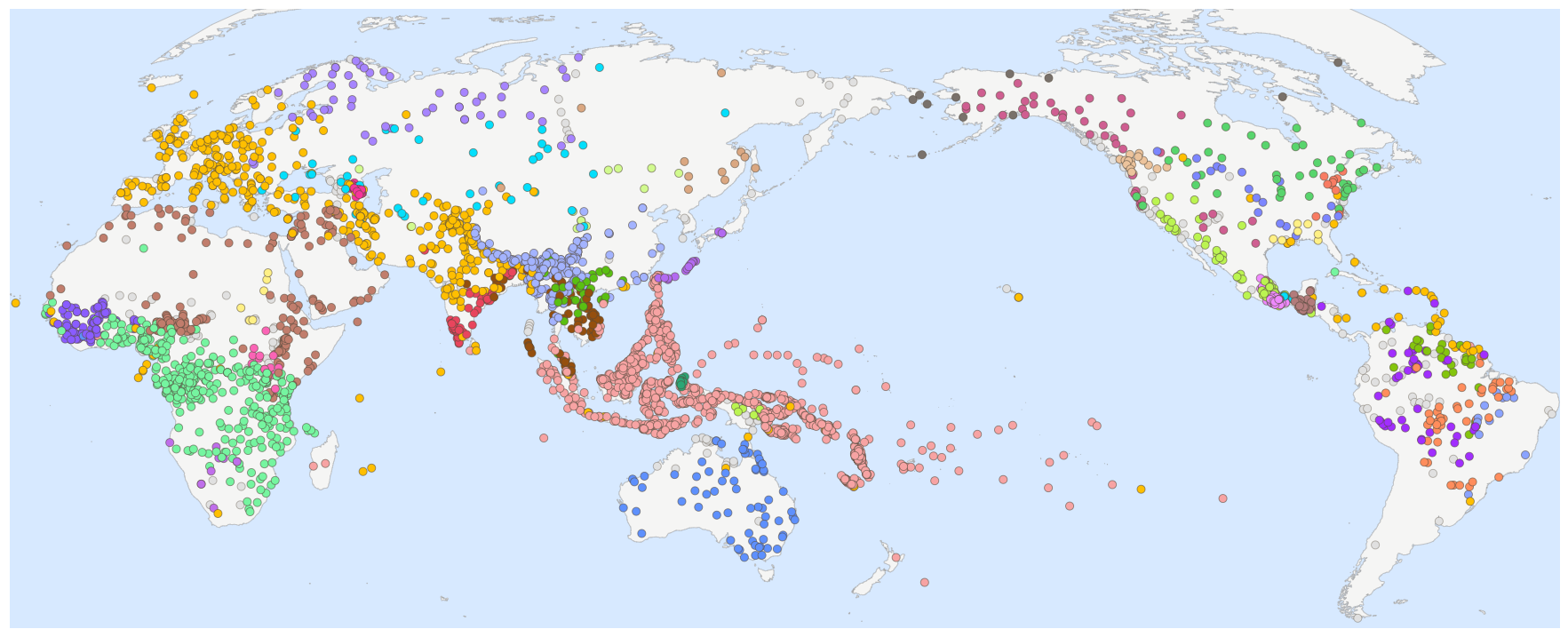
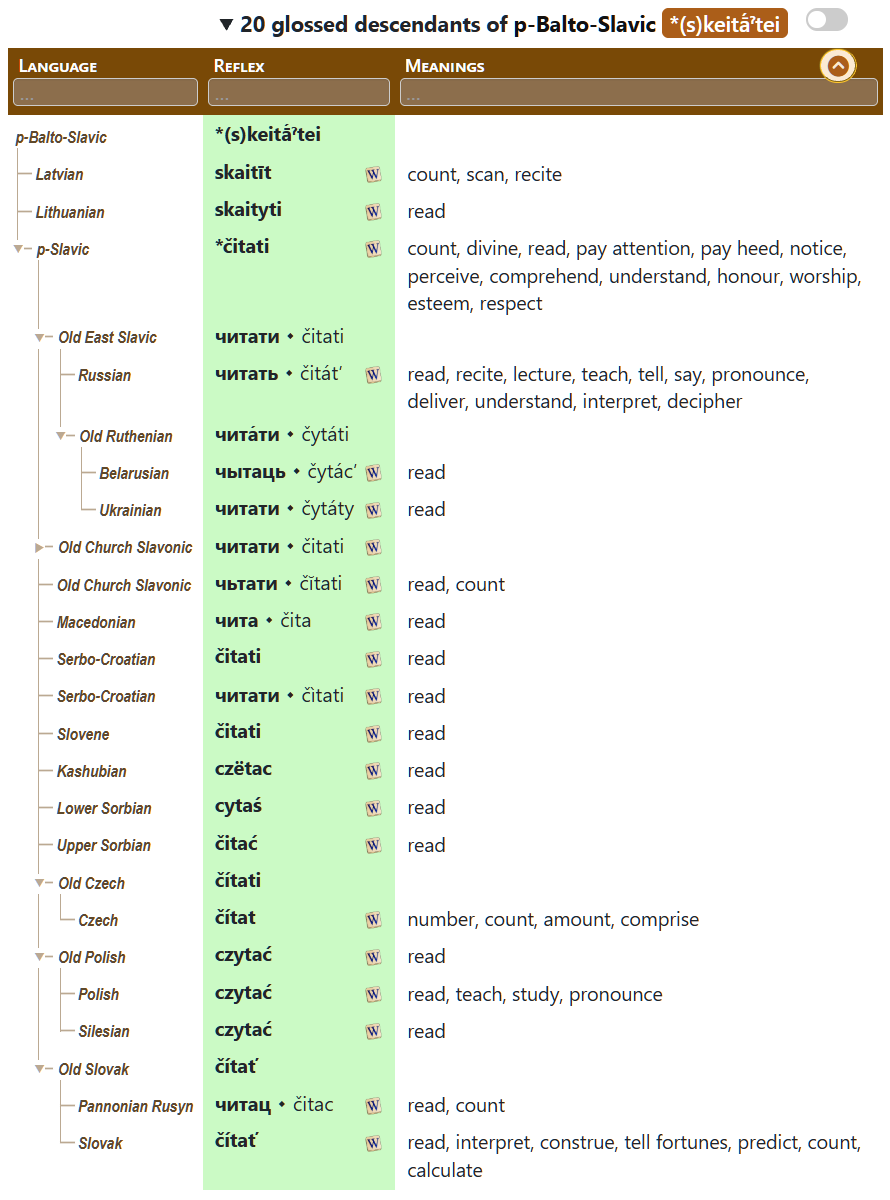
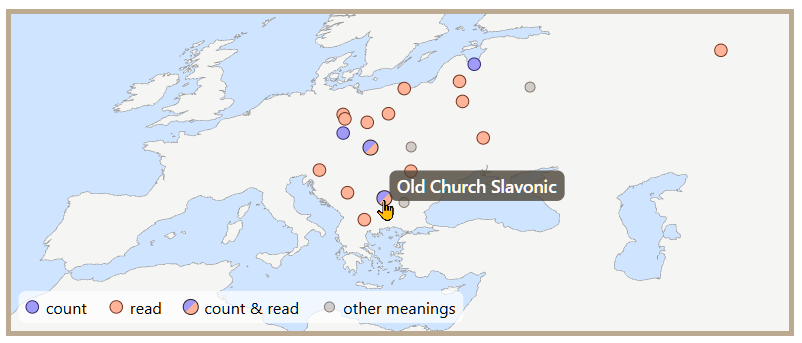
Finally, Fig. 4 illustrates the same semantic link, this time with a p-Balto-Slavic etymon *(s)keitā́ˀtei [link to entry]. Every 𝓔𝓿𝓸Sem entry comes with such a descendance tree, running from the ancestral form (reconstructed or not) to its modern reflexes. Those same reflexes are also displayed on a geographical map [Fig. 5], showing the distribution of the selected senses across languages.
All in all, the particular dialex pattern {count : read} is quite well distributed around the world [Fig. 3], being represented in such families as Indo-European, Uralic, Turkic, Tibeto-Burman, Austronesian, Mande, Bantu, Siouan… This contrasts with many other dialex patterns that show a skewed distribution, being found only in certain specific families or areas.
Because the database 𝓔𝓿𝓸Sem brings together hundreds of thousands of such semantic links, it is a powerful tool to compare semantic links across the world. The search engine 𝓔𝓿𝓸Concepts allows you to explore semantic space and its universal tendencies. For example, if you look up the concept count, you'll see that it has a total of 505 “semantic neighbours”, i.e. other concepts that can be associated with it in language families. The closest neighbours of count are calculate (with δ=59), reckon, number, consider… With its delta score δ=28, read is the 7th closest neighbour of count.
𝓔𝓿𝓸Concepts offers an effective way to explore semantic links, and assess their relative frequency in the world's languages.
You can discover more about the 𝓔𝓿𝓸Sem site through our tutorials — 1/ on our etymograph page, and 2/ on our 𝓔𝓿𝓸Concepts search engine. On either page, click the  icon in the top-right corner.
Further reading
If you wish to know more about 𝓔𝓿𝓸Sem — why and how it was created, or how to read its graphs and tables — you can read our papers:
Mathieu Dehouck, Alexandre François, Siva Kalyan, Martial Pastor & David Kletz. (2023)𝓔𝓿𝓸Sem: A database of polysemous cognate sets. In Nina Tahmasebi et al. (conv.), Proceedings of the 4th Workshop on Computational Approaches to Historical Language Change, 66–75. Singapore. Association for Computational Linguistics.
Alexandre François. (f/c) Lexical typology: Comparing patterns of lexification. In Alexandra Aikhenvald & RMW Dixon (eds.). The Cambridge Handbook of Linguistic Typology, 2nd edition. Cambridge: Cambridge University Press. (
About 𝓔𝓿𝓸Sem 2.0
The first version 𝓔𝓿𝓸Sem was launched in July 2023. The current version, 𝓔𝓿𝓸Sem 2.0, was released in November 2026. Compared to the earlier version, 𝓔𝓿𝓸Sem 2.0 brings a few innovations:
- Etyma are no longer restricted to reconstructed protoforms, but now include also words from attested languages. This has resulted in a significant increase in the size of our database – from 16k to 167k cognate sets in total. The number of languages represented has risen from 3,000 to 5,000; and that of concepts, from 32k to 92k.
- Geographical maps show the distribution of different meanings across languages.
- Cognate sets can now be viewed as a tree of historical descendence – as visible on the etymograph page.
- An updated version of the downloadable dataset.
Download area
The data underlying 𝓔𝓿𝓸Sem can be downloaded from this zipped folder:
Citing 𝓔𝓿𝓸Sem
Here is how you can cite the 𝓔𝓿𝓸Sem database:
Alexandre François, Mathieu Dehouck, Konstantin Henke & Siva Kalyan. () 𝓔𝓿𝓸Sem: A database of semantic links across language families. Online database. Lattice & HéLiCéO, CNRS — ENS‒PSL, Paris. https://tiny.cc/EvoSem [access date: ]